





























A recent motion in Nigeria’s Senate, advocating for a complete ban on textile imports, has reignited critical national discourse. The upper legislative chamber also urged increased funding for the Bank of Industry to bolster the textile sector and called for policies to boost cotton production among farmers. However, history demonstrates that pronouncements alone are insufficient to resurrect an industry once heralded as a beacon of economic success. Achieving genuine Nigeria textile industry revival requires a deliberate, strategic, and sustained commitment to rebuilding the foundations that enabled its past prosperity.
A Glimmering Past: The Heyday of Nigeria’s Textile Industry
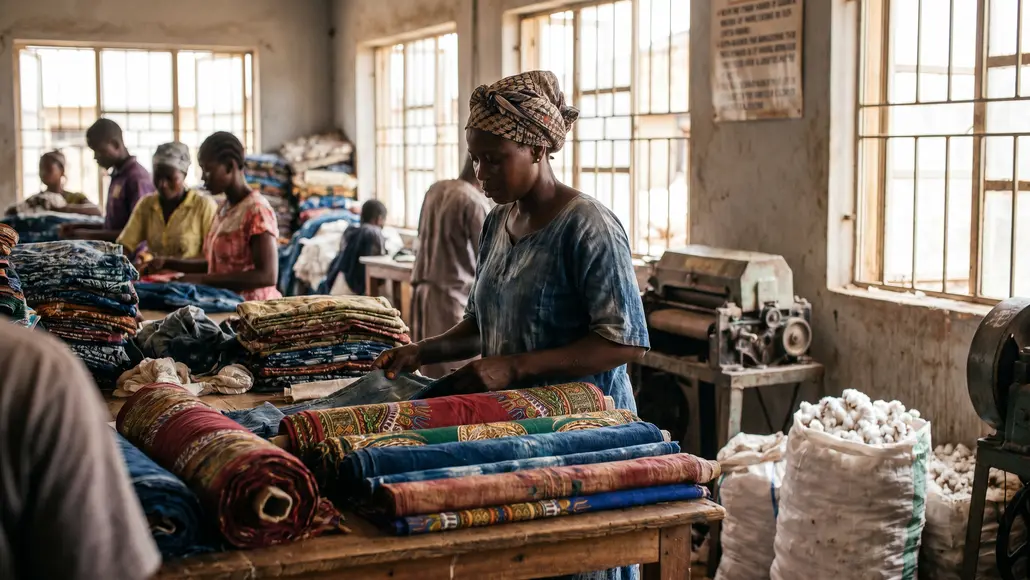
There was a time when Nigeria’s textile industry exemplified industrial aspiration. From the establishment of Kaduna Textile Mill in the 1950s to its boom during the 1970s and 1980s, the textile sector grew to become the third-largest in Africa. At its zenith, Nigeria boasted between 167 and 180 textile mills, operating over 700,000 spindles and more than 17,000 looms. This vibrant industry directly employed an estimated 500,000 to one million individuals and supported hundreds of thousands more, including cotton production farmers, transporters, traders, and ancillary businesses. Major hubs like Kaduna, Kano, Funtua, Lagos, and Aba flourished, with the sector accounting for approximately 25 percent of manufacturing employment and driving crucial non-oil economic growth.
Decades of Decline: Policy Failures and Economic Fallout
The collapse of the Nigeria textile industry was not a singular event but the culmination of decades of policy missteps. Trade liberalization under WTO agreements, executed without adequate safeguards, inundated local manufacturers with imports and smuggled fabrics. Persistent electricity shortages compelled mills to rely on expensive diesel generators, significantly inflating production costs compared to Asian competitors. Rampant smuggling, particularly from neighboring countries, exacerbated the crisis. Outdated machinery, volatile foreign exchange rates, inconsistent tariffs, limited access to finance, and the deterioration of cotton production further compounded the challenges.
Between the mid-1990s and mid-2000s, over half of Nigeria’s textile firms ceased operations. Employment plummeted from well over 100,000 formal jobs to a mere fraction. Today, only a handful of mills remain, many operating far below capacity. Cotton output, which stood at 300,000 tonnes in the 1980s, has dwindled to just 15,000 tonnes currently. The number of cotton production farmers has sharply declined from 620,000 to approximately 100,000, with average yields falling significantly due to issues like contaminated seeds. Industry data indicates that from 1994 to 2005, around 64 percent of registered textile companies disappeared, shrinking from 125 to 45. Employment dropped from 137,000 in 1996 to 24,000 in 2008, and by 2022, fewer than 20,000 jobs remained. Currently, only about five textile mills are operational, including Sunflag Group, Nichemtex, ATM, Funtua Textiles, and Chellco Industries. Even Dangote General Textiles closed in 2024, leaving the sector’s labor force at less than 2,000, encompassing both direct and indirect roles.
Persistent Demand and Missed Opportunities
Despite the industrial decline, demand for textiles never waned; instead, a burgeoning population ensured it soared. Nigeria’s annual textile and apparel market is valued at an estimated $5 billion to $7 billion, requiring roughly 1.2 billion to 1.5 billion meters of fabric annually. Local manufacturers can only meet a minimal portion of this. Textile imports reached over N814 billion in the first nine months of 2025, an increase from N522.3 billion a year prior, according to NBS data. It is estimated that more than N2.7 trillion leaves the country yearly on imported fabrics and garments, effectively exporting jobs and industrial opportunities on a massive scale.
Ironically, Nigeria failed to capitalize on opportunities even when preferential market access was available, such as under the United States African Growth and Opportunity Act (AGOA). Rather than fostering domestic garment manufacturing capacity, reports suggest many traders imported fabrics from other countries, rebranded them as Nigerian products, and then exported them, thereby missing a crucial chance to establish the nation as a significant textile and garment exporter.
Lessons from Global Peers and a Path Forward
Other nations adopted different strategies. Bangladesh, with virtually no textile sector five decades ago, now generates over $45 billion annually from garment exports and employs more than four million workers. Vietnam’s textile and garment exports reached $18.8 billion in the first five months of 2026, marking a 5.6 percent year-on-year increase, with the sector targeting $50 billion in total annual export revenue for 2026. Even Ethiopia, despite recent economic challenges, has made substantial investments in industrial parks dedicated to garment manufacturing. The clear lesson is that textiles can anchor industrialization when governments consistently support the entire value chain.
There are encouraging signs of renewed interest. The National Economic Council’s approval of a Cotton, Textile and Garment Development Board and ongoing efforts to strengthen cotton production are positive steps. The Senate has urged relevant government ministries to actively work towards reviving textile industries nationwide. Industry experts consistently highlight key priorities for Nigeria textile industry revival: reliable electricity, modern machinery, affordable financing, robust border controls, policy consistency, and the revitalization of cotton production through improved seeds and extension services.
However, Nigeria must avoid the trap of believing that import bans are the sole solution. Protectionism without competitiveness risks creating scarcity and fueling smuggling, as evidenced by the continued prevalence of banned products like poultry and refined vegetable oil in local markets. Millions of Nigerians, despite absolute import bans, still rely on affordable, used imported apparel. The true challenge lies in making Nigerian textile producers globally competitive.
Experts estimate that a fully revitalized cotton, textile, and garment manufacturing ecosystem could create over one million jobs in garment production alone, and potentially two million across the broader value chain. This would significantly reduce import dependence, conserve foreign exchange, and expand non-oil exports under the African Continental Free Trade Area (AfCFTA), fostering substantial economic growth. Such a revival demands more than mere nostalgia; it requires industrial parks with dedicated power, modern production technology, vocational training centers, digital manufacturing capabilities, and world-class logistics. The Aba garment cluster in Abia State, with approximately 100,000 producers, illustrates the potential when sound policies and local initiative converge with structured support.
Ultimately, Nigeria’s textile narrative is about industrialization, job creation, and economic sovereignty. Capturing just 10 percent of Bangladesh’s current output could yield $4.5 billion in potential export revenues. The Senate is right to highlight the sector’s decline. However, unless the government restores the fundamental conditions that once sustained this industry and modernizes them for contemporary competition, the latest resolutions will merely join a long list of well-intentioned but unimplemented plans. Nigeria does not need more pronouncements about Nigeria textile industry revival; it needs a comprehensive strategy for economic growth in the sector and the discipline to execute it effectively.

