





























Ordering clothing online should be straightforward, yet the industry’s most persistent frustration remains the simplest question: will it fit? A label such as “L” or “48” can vary widely depending on the brand, cut, category or geography, and two items carrying the same size tag can have noticeably different measurements. Add the reality that shoppers have different proportions and distinct preferences snug, relaxed, oversized and the problem becomes harder still.
That inconsistency has made online size and fit one of fashion e-commerce’s most expensive operational headaches. Across European online fashion, return rates can reach about 50%, with size and fit responsible for as much as half of all returns. In denim, the challenge is even more pronounced, with returns reported as high as 65% in some cases.
Zalando says it has been tackling the issue at scale since 2018 and claims it is the only e-commerce platform offering a broad suite of size-and-fit solutions across its ecosystem. The company now has an in-house team of around 80 specialists working across fashion, machine learning, AI, computer vision and 3D technologies. Zalando reports that in 2025 its tools prevented 8% of size-related returns overall, reinforcing the company’s view that reducing misfit is achievable but requires multiple layers of solutions rather than a single fix.
Rebuilding the feedback loop that mass production removed
Zalando frames the roots of the problem as structural. Tailoring once relied on direct dialogue between maker and wearer; industrialisation made clothing widely available, but removed much of that feedback. Digital commerce, Zalando argues, provides a chance to restore the loop using data: product measurements and cut, customer preferences, body dimensions and fit feedback can be combined to generate more accurate guidance and to identify where sizing is repeatedly failing.
Its strategy is built in stages. First, Zalando developed systems to interpret how garments run across brands and categories, using machine learning to analyse product data, return behaviour and customer feedback. Second, it layered in customer-specific signals body measurements and fit preferences to personalise recommendations. Third, it aimed to bring the experience closer to an in-store try-on through its Virtual Fitting Room.
Foundational tools: flags, recommendations and fitter insight
Zalando’s earliest work focused on building a baseline understanding of product fit across a diverse assortment. That foundation powers the “size flags” and “size recommendations” shoppers see on product pages today. Flags indicate whether an item typically runs small or large; recommendations suggest the most likely size to fit a specific customer.
The system draws on multiple inputs: brand-provided information, purchase and return patterns, customer fit feedback and internal “fitting models” trained specialists who physically try on items to spot sizing issues before they become widespread. Zalando says these foundational solutions now cover roughly 70% of its assortment and that the insights can also be shared with brands, helping them see whether certain fits or collections drive repeat returns.
Personalisation: from size history to body measurements
Product-level guidance becomes sharper when the platform understands the shopper. Zalando’s Size Profile lets customers indicate which brands and items fit well, including products bought outside Zalando, and to rate fit on past orders. Those signals help tailor browsing, filtering and recommendations toward items more likely to match a customer’s typical sizing and preferred fit.
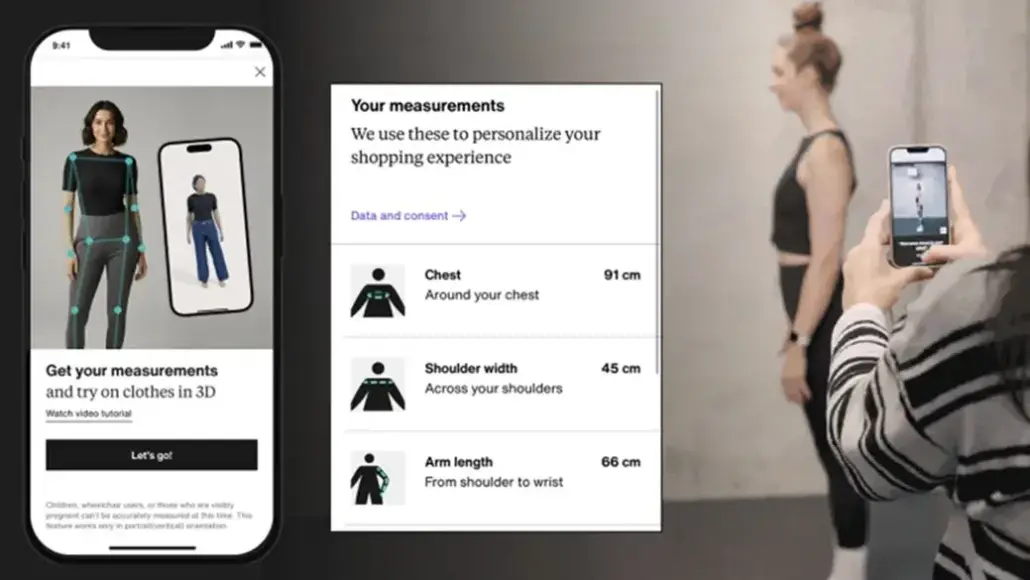
The Body Measurement tool adds another layer by capturing measurements from two photos or a short video recorded on a phone. Zalando says more than 1.5 million customers have used the feature so far, helping build what it describes as Europe’s largest anonymised dataset of fashion body measurements. These insights are also incorporated into size charts so shoppers can compare their own measurements with product dimensions and choose sizes aligned with how they want items to sit looser, slimmer or more oversized.
Virtual Fitting Room: bringing fit into view
Once product and customer data are connected, Zalando uses that information to create a 3D avatar for its Virtual Fitting Room, allowing shoppers to visualise how different sizes might look on their body shape.
The company highlights jeans as a prime use case: a single style can come in more than 30 size combinations, and differences in waist, hips, leg shape and length make denim hard to buy online with confidence. About 21% of Zalando customers purchase jeans annually, yet the category is also among the worst for size-related returns.
Zalando says pilots of the Virtual Fitting Room reduced returns by up to 40%. After successful tests, it is moving from pilots to a permanent, scaled experience, with the goal of making it available to all customers and expanding the eligible assortment.
Fewer returns, better insight, lower impact
Zalando’s immediate objective is to reduce avoidable returns by helping shoppers choose correctly the first time cutting unnecessary shipments and associated emissions. The longer-term ambition is broader: using fit intelligence to show where products repeatedly fail, guide brands toward better sizing decisions and gradually reduce friction across the industry.
“Our ambition is to help online shoppers find the right fit for the first time wherever and however they shop. We are building towards a digital tailor for online fashion that combines our understanding of products with each customer’s unique measurements and fit preferences. This can help people find what fits them best and, over time, give brands better insight into the products their customers need and want.” Pelin Anli Bedirhanoglu, Director of Size & Fit at Zalando.
As online size and fit becomes central to customer satisfaction, logistics costs and sustainability goals, Zalando is betting that technology combined with human fitting expertise can turn one of e-commerce fashion’s biggest pain points into a competitive advantage.