























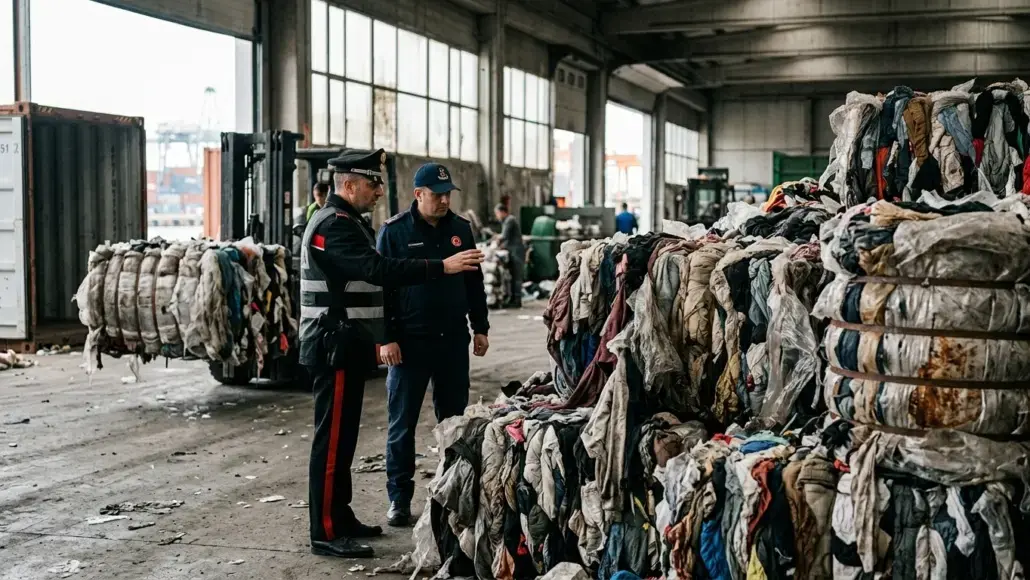
European anti-fraud investigators say they have broken up a lucrative operation that moved thousands of tonnes of illegal textile waste from Italy into Turkey by disguising shipments to sidestep strict environmental rules and the higher costs of recycling. The European Anti-Fraud Office (OLAF), working with Italy’s Carabinieri and Turkish customs officials, said the inquiry identified and intercepted around 4,200 tonnes of textile waste that had been exported unlawfully.
Authorities said the case centred on waste streams containing high levels of acrylic fibres—materials that can persist in the environment for up to two centuries and typically require more complex, expensive handling. Investigators believe the consignments were falsely labelled to evade the controls that apply to such synthetic-heavy waste.
“Schemes such as this one that offer ways to illegally avoid the cost of recycling certain kinds of textile waste or complying with environmental rules are an opportunity for organised networks to make illegal gains,” said OLAF director general Petr Klement.
OLAF said it used trade-flow analysis, customs records and checks on recycling capacity to flag suspicious shipments and alert Turkish authorities. Inspections upon arrival then uncovered the 4,200-tonne volume, prompting a wider on-the-ground investigation.
That follow-up inspection—carried out jointly in Turkey by OLAF staff, Italian environmental specialists and Turkish officials—revealed additional stockpiles. Inspectors found nearly 2,100 tonnes stored in a warehouse linked to a Turkish recycling facility that was allegedly not compliant with environmental law, along with another separate cache.
Investigators later traced more waste connected to the same network. “A further 768 tonnes of textile waste originating from Italy and connected to the same fraudulent scheme were found stored in the Turkish port of Mersin, also incorrectly labelled and ready to be illegally dumped,” OLAF said.
Enforcement action has also escalated in Italy. OLAF said the Carabinieri raided a business complex in Brescia connected to the suspected exports, seizing company sites, a fleet of trucks allegedly used in the operation, and about €12 million in financial assets.
The bust comes as Europe’s clothing waste problem grows more visible. The EU textile and clothing sector generated €170 billion in turnover in 2023 and employs about 1.3 million people, yet recycling remains costly and technically difficult. In 2019, Europe produced roughly 12.6 million tonnes of textile waste, with only about 20% collected separately for reuse or recycling.
The European Commission tightened textile-waste rules in 2025 to curb waste being misdeclared as reusable goods and shipped abroad, expanding oversight of shipments and strengthening OLAF’s role in tackling waste trafficking.
Separately, a group of five EU countries led by France has urged tougher action on ultra-fast fashion, calling for stronger online platform oversight, tighter market surveillance and reinforced enforcement to address the surge in illegal textile waste generated by overconsumption. France’s ecological transition minister Monique Barbut said: “We are relatively ahead in this area and we are pleased to be able to share our experience and how Europe can move forward together on this topic as well.”