
























Vietnam’s textile and garment industry is accelerating its green and technological transition as global fashion brands continue to tighten sustainability and traceability standards. This shift is increasingly seen as essential to retaining international orders and advancing further up global value chains.
Green Transition Becomes a Competitive Requirement
According to the Ministry of Industry and Trade, Vietnam’s garment and textile exports generated 46 billion USD in 2025, with the sector now targeting 48 billion USD in 2026. As of August, Vietnam textile exports had reached approximately 26.9 billion USD, reflecting a year-on-year increase of 1.6%.
While the figures confirm that the sector remains competitive on the global stage, it continues to face growing pressure from rising production costs, evolving trade policies, and new international standards covering green transition, emissions control, and circular production practices.
The global garment and textile market is also changing the way suppliers are evaluated and selected. Alen Wei, CFO of H&M Production China and Southeast Asia, noted that fashion brands are no longer looking only for commercially capable supply chains. Sustainability, innovation, resilience, and long-term value creation have become equally important criteria.
For H&M, while products remain central to business decisions, competitiveness is increasingly understood as a combination of fashion, quality, price, and sustainability. Suppliers are expected to continuously improve efficiency, productivity, and innovation. Where production capacity, cost, and delivery timelines were once the decisive factors, businesses must now meet requirements that extend across materials, environment, energy, chemicals, working conditions, and responsibility throughout the entire supply chain.
Emissions reduction is especially relevant to the textile and garment sector, given its nature as an energy- and resource-intensive industry. According to Alen Wei, H&M and many other fashion brands are actively pursuing net-zero emissions across their value chains while promoting the wider use of recycled materials.
Vietnam Positioned as a Global Manufacturing Hub — With More Expected
At the Vietnam International Sourcing 2026 event, organised by the Ministry of Industry and Trade in Ho Chi Minh City, international garment and textile buyers acknowledged that Vietnam has established itself as an important global textile manufacturing hub, citing the country’s production capacity, skilled workforce, economic integration, and adaptability as key strengths.
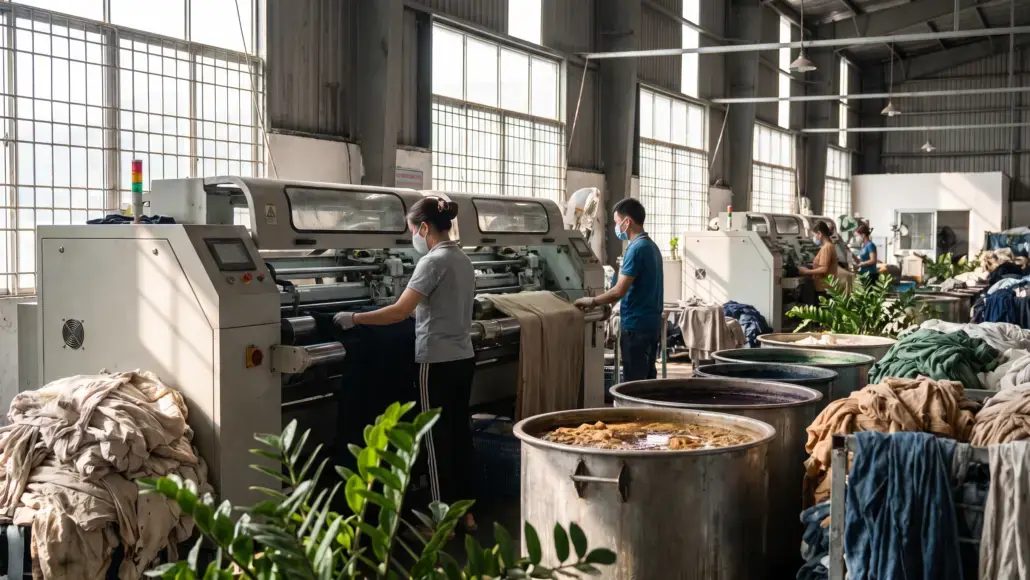
However, the next stage calls for the sector to move beyond its traditional role as primarily a manufacturing hub, transitioning instead toward becoming a destination for green, high-tech, circular, and high-value production — a direction well aligned with the sustainable garment industry trends now shaping global sourcing decisions.
Trade Policy Pressures Add to the Urgency
Alongside environmental requirements, Vietnamese garment and textile businesses are also navigating the impact of shifting international trade policies. Do Ngoc Hung, Trade Counsellor and head of the Vietnam Trade Office in the United States, pointed out that US tariff policies applied across many economies are likely to affect consumer purchasing power and importers, potentially reducing the price competitiveness of Vietnamese exports.
Nevertheless, major US suppliers and distributors have not yet planned changes to their sourcing partners, and Vietnam continues to be regarded as a strategic partner for large groups operating in garment and textile, footwear, and other labour-intensive industries.
Hung described this as a positive signal but also underscored the urgent need to strengthen the competitiveness of Vietnamese goods through factors that go beyond price. He called on businesses to improve production capacity, increase the use of domestic materials and technologies to generate greater added value, and reduce the risk of trade-remedy investigations or concerns around opaque sourcing from third countries.
Transforming the Supply Chain from Within
In response to these market changes, many Vietnamese garment and textile companies have proactively shifted their strategies, treating green transition and innovation as integral parts of their business development rather than simply meeting export requirements.
Nguyen Thi Hong Trang, Deputy Head of the Research, Development and Investment Division at Corporation 28, said that international customers have increasingly prioritised green and sustainable products, from materials and energy use to working conditions. In response, the company has upgraded its production capacity and is gradually shifting toward greener operations.
Faslink Vietnam has taken a parallel path, focusing on researching new and recycled materials and applying advanced technology across its processes. Tran Hoang Phu Xuan, Director of Faslink Vietnam, said the company has shifted from simply manufacturing products to providing comprehensive solutions for buyers. Through its recycling solutions, Faslink has achieved a reduction in CO2 emissions of approximately 59% and a 47% decrease in water consumption compared with conventional production processes.
The Road Ahead for Vietnam’s Textile and Garment Sector
As international brands continue to seek suppliers capable of combining price, quality, speed, innovation, and sustainability, Vietnam’s garment and textile sector still holds significant opportunities within the global textile supply chain. Industry experts recommend that the sector move beyond simple processing and advance toward higher-value stages, including design, product development, supply-chain management, and greater control over raw materials.
This transition should be accompanied by investment in workforce skills, digital technologies, automation, trend forecasting, and data management — all aimed at improving productivity and securing Vietnam textile exports in an increasingly demanding global market built around circular production standards.