
































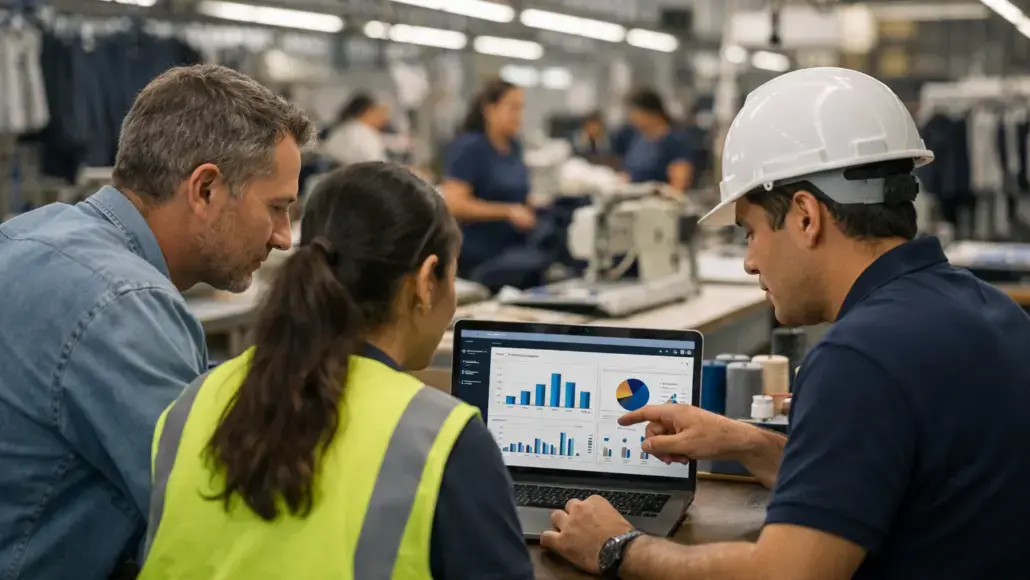
Honduras-based textile and apparel manufacturing conglomerate Grupo Beta has implemented the CreateOne AI-driven product creation platform into its operations, achieving results that have drawn significant attention across the industry. The deployment moved from proof of concept to full enterprise implementation in just three weeks — a timeline that stands in stark contrast to legacy technology rollouts that can take years.
The numbers behind Grupo Beta’s use of the CreateOne platform were notable: over 1,600 questions answered, more than 100 applications generated, and an adoption rate that surprised even experienced technology professionals. Daren Hull, CEO of CreateOne, acknowledged that the pace was unlike anything previously observed with a client.
The Core Problem: Do Factories Really Know Their Costs?
The platform, developed by Resonance, is designed to sit as an economic decision layer atop existing supply chain or ERP systems, running real-time calculations to determine whether a given order or set of orders is actually profitable. Factories today are committing to materials and labor before knowing whether an order will return a margin — a structural challenge made worse by tripling container costs and shifting tariff environments.
Lawrence Lenihan, Resonance’s executive chairman and co-founder, framed the problem in direct terms. The issue is not simply a lack of data — it is a lack of operating truth. A factory may expect 100-yard material rolls and receive 50-yard rolls instead, instantly invalidating its cost assumptions. Traditional systems often require workers to export data into dozens of spreadsheets — in one cited case, as many as 90 — which makes timely, accurate decision-making nearly impossible.
Lenihan and his team drew on nine years of directly running a plant, brands and a closed-loop manufacturing system. That firsthand experience shaped the architecture of CreateOne, which combines AI with swarms of agents, a memory system and a hybrid temporal graph network sitting atop a directed acyclic graph — producing what Lenihan described as deterministic outputs that reflect real costs in real time.
Profitability Is a Portfolio Problem
One of the key insights driving the platform is that factory profitability is not determined order by order — it is a portfolio question. Two individually unprofitable orders may become highly profitable when combined due to shared operations and maximized efficiency. The system accounts for this complexity, enabling factories to reorganize their book of orders to optimize margins across the whole.
The granularity extends to depreciation, maintenance costs and even thread expenses. For manufacturers competing in the Western Hemisphere, the platform’s ability to identify idle labor during changeovers as a primary cost driver reshapes how factories measure and pursue efficiency.
In one live example shared by Hull, a customer with nine active orders was shown a blended margin of 2.1 percent across the group, a 2.5 percent margin on the most profitable single order and a flagged sewing efficiency issue potentially tied to missing payroll data on the production floor.
Grupo Beta’s Path to Deployment
Rod Rozell, Chief Operating Officer of Grupo Beta, reconnected with Hull and Lenihan after recognizing that the platform had matured into something capable of transforming operations at scale. He emphasized that AI’s value is diminished when different departments use separate tools without integrating insights — and that CreateOne’s unified approach addresses this limitation directly.
Rozell described the leap in capability as moving from steam locomotives to a fundamentally different mode of transportation entirely. He also highlighted the speed of onboarding, noting that Grupo Beta was wired on July 24th and within weeks was ready to move from proof of concept to live implementation.
The platform is being used not by engineers but by staff in planning, finance and operations — and observations from frontline workers are feeding directly into the system’s evolving model. For an industry navigating AI apparel manufacturing adoption without a clear roadmap, CreateOne’s rapid, floor-level deployment offers a concrete illustration of what a working strategy can look like.

