





























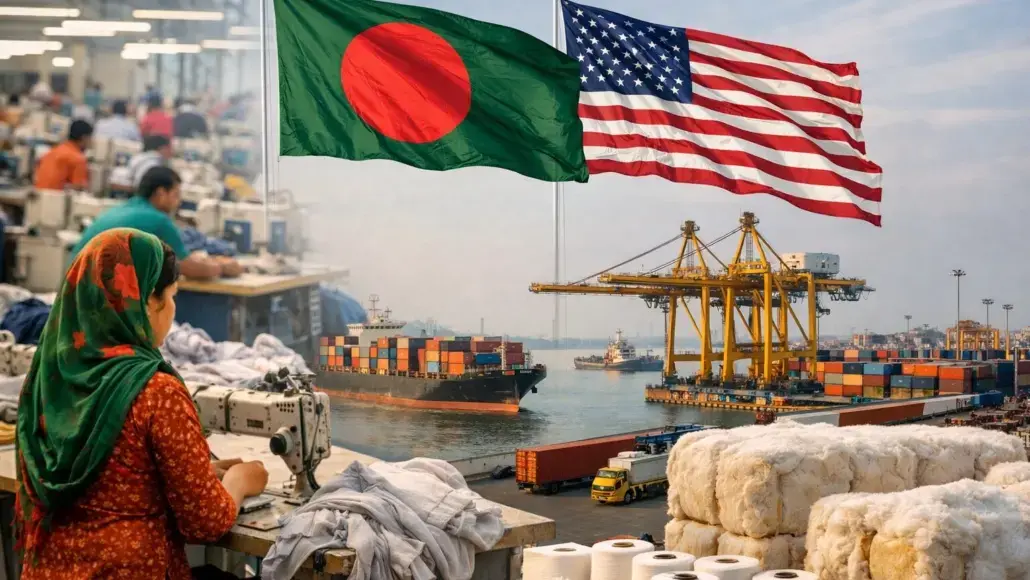
For decades, Bangladesh built its garment industry on one enduring promise: the lowest possible price. That promise, once a near-unassailable competitive edge, is no longer proving sufficient to hold ground in the United States – the single most important export destination for Bangladesh’s ready-made garment sector.
A convergence of factors – rising tariffs, intensifying regional competition, shifting buyer priorities, and a structurally changing retail landscape – is placing Bangladesh apparel exports under mounting pressure in the US market, raising serious questions about the sector’s long-term positioning.
The Numbers Tell a Difficult Story
Bangladesh’s share of the US apparel import market has been slipping. While the country remains one of the largest suppliers of garments to American retailers, its growth trajectory in that market has not kept pace with some competing nations. US apparel buyers are increasingly diversifying their sourcing away from Bangladesh, even as the country continues to offer competitive manufacturing costs.
According to data referenced in industry discussions, countries such as Vietnam, India, and even newer entrants are capturing greater attention from US buyers, in part because they offer a broader product mix, faster turnaround times, or more favourable trade terms – advantages that pure cost leadership cannot easily offset.
Tariffs Adding to the Burden
One of the most direct pressures on Bangladesh apparel exports to the United States is the tariff structure. Unlike several competing nations that benefit from preferential trade agreements with the US, Bangladesh does not enjoy duty-free access to the American market. Garments exported from Bangladesh face tariffs that can range significantly depending on product category, putting Bangladeshi exporters at a structural disadvantage compared to peers operating under free trade arrangements.
This tariff gap has long been a concern for Bangladesh’s RMG exports, but it has grown more acute as US buyers become increasingly cost-conscious in a challenging domestic retail environment. When tariff differentials are layered on top of rising production costs within Bangladesh itself – including wages, energy, and compliance expenditures — the price advantage that Bangladesh apparel exports once commanded begins to narrow considerably.
Compliance and Sustainability: A Double-Edged Demand
The demands placed on Bangladesh’s garment industry by US buyers have also grown more complex. Beyond price, buyers increasingly require demonstrated compliance with environmental, social, and governance standards. Bangladesh has made meaningful investments in green factory infrastructure – the country hosts some of the highest numbers of LEED-certified garment facilities in the world – yet translating those investments into commercial advantage in the US apparel market has proved uneven.
US retailers and brands are pressing suppliers on issues ranging from carbon footprint and chemical management to worker welfare and supply chain transparency. Meeting these requirements demands ongoing capital expenditure and management capacity, costs that smaller and mid-tier Bangladeshi manufacturers often struggle to absorb while simultaneously competing on price.
Product Diversification Remains a Gap
A recurring vulnerability highlighted in assessments of Bangladesh’s RMG exports is the country’s heavy dependence on a relatively narrow product range – predominantly basic knitwear and woven categories such as t-shirts, trousers, and casual wear. While Bangladesh dominates in these segments, the higher-value categories – technical wear, performance fabrics, outerwear, and lifestyle apparel – remain underdeveloped in Bangladesh’s export basket.
US apparel buyers seeking more complex or value-added products frequently turn to other sourcing destinations that have invested more deeply in product development, design capability, and raw material integration. For Bangladesh apparel exports to regain and extend ground in the US market, a meaningful shift toward higher-value product categories is widely seen as essential.
The China-Plus-One Factor and Its Limits
The global sourcing strategy widely referred to as “China-plus-one” – in which brands reduce reliance on Chinese manufacturing by adding alternative supplier countries – initially appeared to offer Bangladesh a significant opportunity. However, the benefits of this reorientation have not flowed as fully to Bangladesh as many in the industry anticipated.
Vietnam, in particular, has captured a disproportionate share of orders redirected away from China, owing to its stronger presence in higher-value segments, its trade agreement network, and its proximity to Chinese raw material supply chains. Bangladesh’s RMG exports have benefited to some degree from supply chain diversification trends, but not to the extent that its production scale and cost structure might theoretically support.
Freight, Lead Times, and Logistics Pressures
Geography and logistics also play into Bangladesh’s competitive position in the US apparel market. Longer lead times relative to nearshore competitors in the Western Hemisphere, combined with periodic port congestion and logistics disruptions at Chittagong, have made agility-focused US buyers cautious about deepening their Bangladesh sourcing for fast-replenishment programmes.
As US retailers continue to reduce inventory risk and shorten buying cycles in response to unpredictable consumer demand, suppliers that can offer speed and flexibility alongside cost competitiveness gain a structural advantage – one that Bangladesh’s garment industry, despite its enormous scale, has found difficult to fully match.
Industry Voices and the Path Forward
Leaders within Bangladesh’s garment industry and trade bodies have acknowledged that the sector must evolve beyond its low-cost identity. Discussions within the industry point to the need for investment in technology, workforce skills upgrading, raw material backward linkage development, and brand-building capacity if Bangladesh apparel exports are to remain competitive in the US and other premium markets over the long term.
The Bangladesh Garment Manufacturers and Exporters Association and related industry bodies have consistently advocated for preferential trade access to the US market — a structural remedy that could partially offset the tariff disadvantage – though no concrete policy progress on that front has been reported to date.
A Sector at a Crossroads
Bangladesh’s RMG exports remain a cornerstone of the national economy, accounting for the overwhelming majority of the country’s foreign exchange earnings and employing millions of workers, a significant proportion of whom are women. The stakes of the sector’s performance in the US apparel market – its largest single buyer country are therefore not merely commercial but deeply social and economic.
The message emerging from current market dynamics is clear: low cost alone is no longer a sufficient value proposition for Bangladesh apparel exports in the US market. Competing effectively going forward will require a more complex and diversified offering – one that combines cost efficiency with quality, compliance, speed, and product sophistication.
Whether the sector can execute that transition at the pace and scale required remains the defining challenge for Bangladesh apparel exports in the years ahead.

