
























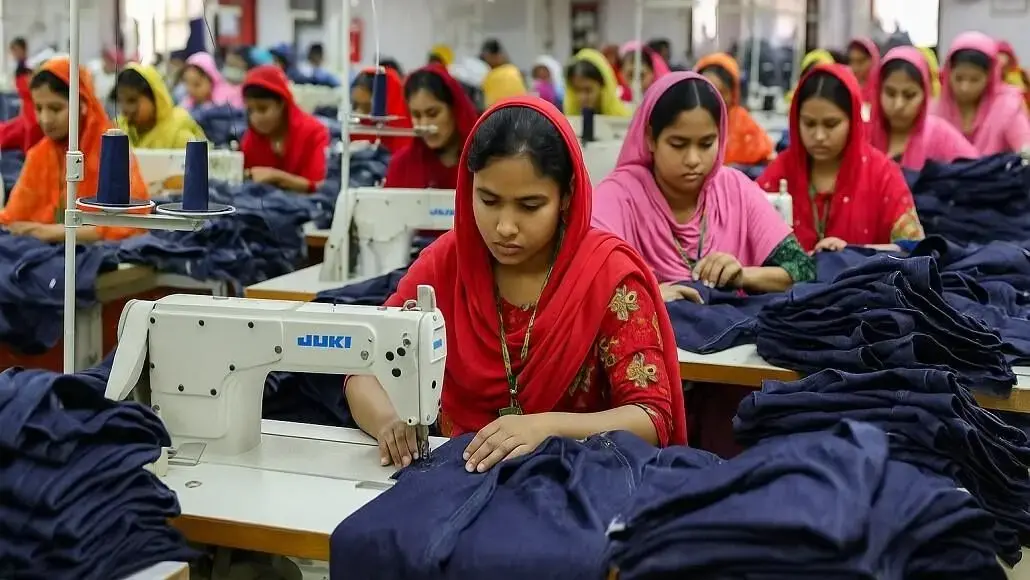
Bangladesh’s ready-made garment (RMG) industry witnessed significant workforce reductions during the first six months of the year, with reports indicating that more than 20,000 employees lost their jobs as factories grappled with mounting operational and financial pressures.
Information compiled from the Industrial Police, the Bangladesh Garment Manufacturers and Exporters Association (BGMEA), and the Bangladesh Knitwear Manufacturers and Exporters Association (BKMEA), and reported by Prothom Alo, points to an increasing number of factory closures and employee retrenchments across the country’s key industrial zones.
The Bangladesh garment layoffs have largely affected the RMG sector, a cornerstone of the nation’s export-driven economy. While manufacturers attribute the workforce reductions to weakening business conditions, labour representatives have offered a different perspective on the reasons behind the dismissals.
Factory owners argue that reduced international orders, combined with difficulties in obtaining bank financing, have placed many businesses under severe financial strain. According to industry representatives, these challenges have forced some manufacturers to shut down operations permanently, while others have resorted to downsizing their workforce in an effort to remain operational.
Labour organizations, however, dispute the extent of the decline in export demand. They contend that garment shipments have not dropped enough to justify such widespread job losses. Union representatives have also alleged that some employees were dismissed because they were involved in efforts to establish trade unions after recent changes simplified the legal process for union registration.
Despite concerns surrounding employment, Bangladesh’s garment export performance has shown mixed results. Data from the Export Promotion Bureau (EPB) revealed that apparel exports reached US$39.35 billion during fiscal year 2024-25, reflecting annual growth of 8.84%. However, exports during the first eleven months of the fiscal year totaled US$35.31 billion, representing a 3.41% decline compared with the corresponding period of the previous year.
Industrial Police records cited in the report indicate that 79 factories across eight industrial regions laid off 7,784 workers during the first five months of the year. The highest concentration of dismissals occurred in March and May, coinciding with the Eid-ul-Fitr and Eid-ul-Adha holiday periods.
Figures released by BGMEA showed that 80 member factories collectively retrenched or terminated 19,188 employees during the first half of the year. The affected facilities included 18 factories in Dhaka, 22 in the Savar-Ashulia industrial belt, and 40 in Gazipur. Among these businesses, 27 factories have reportedly ceased operations, while the remaining units continue production.
Gazipur alone accounted for a substantial share of the workforce reductions. According to Industrial Police data referenced by Prothom Alo, 44 factories dismissed 2,155 workers between January and June. Seven factories, including APS Apparels and Evince Textile, linked the dismissal of 556 employees to shrinking export orders and financial constraints. The remaining 37 factories cited labour disputes, production interruptions, employee misconduct, and suspected document forgery as reasons for terminating another 1,599 workers.
The Bangladesh garment layoffs have also intensified discussions surrounding workers’ rights. Former Industrial Bangladesh Council secretary general Salahuddin Swapan told Prothom Alo that some employees had been dismissed due to their involvement in union activities following the easing of legal requirements for union formation.
BGMEA President Mahmud Hasan Khan told the publication that factory closures were primarily the result of declining orders, restricted access to bank financing, and business owners exiting the industry. “At the same time, new factories are also being established, which is why overall exports have not fallen significantly,” he said, adding that the actual number of layoffs could exceed 19,000 because not every dismissal may have been officially reported.
BKMEA President Mohammad Hatem also told the newspaper that persistent shortages of export orders and tighter lending policies have placed additional pressure on manufacturers, contributing to continuing factory closures and workforce reductions across Bangladesh’s textile and apparel industry.