


























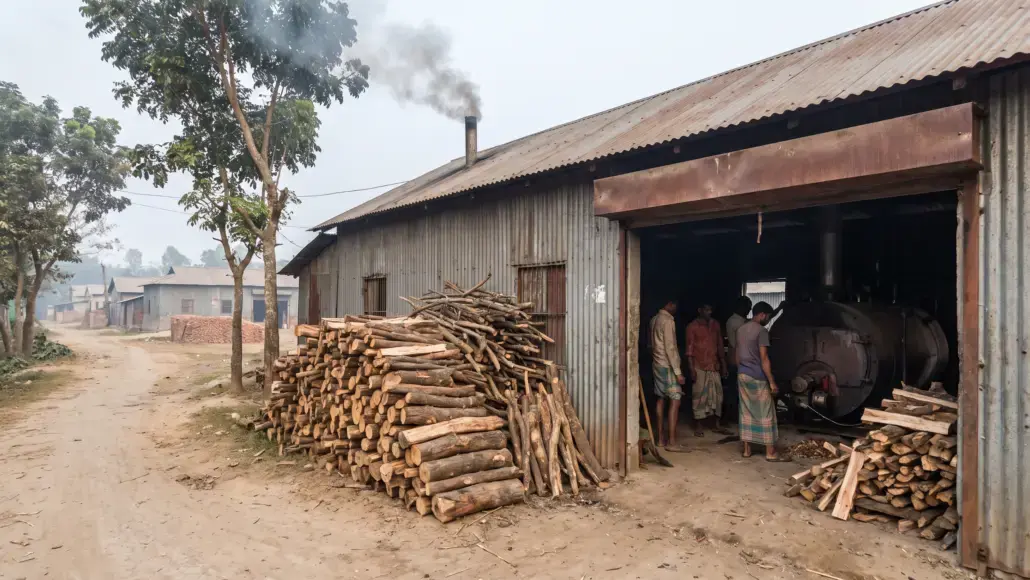
At least 100 small and large textile factories in Narsingdi, Bangladesh are currently burning wood as an alternative fuel to keep their operations running, as a deepening gas shortage and sharply rising prices of jhut — locally used textile waste — continue to squeeze the district’s industrial sector. The situation is causing severe environmental damage and mounting financial strain for factory owners and workers alike.
Of the 100 factories burning timber, around 50 have turned to firewood specifically because of the gas crisis, while the remaining 50 have made the switch due to the increased cost of textile waste, which was previously a common alternative fuel for boilers. Beyond those still managing partial production, more than 100 additional factories in the district have been forced to halt or severely disrupt operations altogether, leaving thousands of workers idle as gas pressure in the area drops to near zero.
Crisis Forces Hands at the Factory Floor
During a visit to the Chowala industrial area, workers at Haque Textile and Unifil Textile were observed burning wood in steam boilers. Md Shakhawat, a boiler operator at Haque Textile, explained that jhut had previously served as the alternative fuel of choice.
“Previously, we used textile waste to run the boilers as alternative fuels. But as the price of waste fabric has increased, we are now burning wood,” he said.
Sizing mills — which process yarn — are among those using firewood to power steam boilers, with each factory spending more than Tk 12,000 a day on wood fuel alone.
Kawsar Hossain, assistant manager of Unifill Textiles Mills Ltd, confirmed that his factory has been compelled to use firewood due to insufficient gas supply. “We are being forced to use firewood as we are not getting enough gas. We are having to turn down orders from our buyers because we cannot maintain production due to the gas crisis,” he said, adding that around 30 to 35 factories in the district town alone have recently resumed burning firewood. The actual number across the wider district is believed to be significantly higher.
Scale of the Problem in Narsingdi’s Industrial Sector
Narsingdi is home to more than 3,000 small and large factories, of which approximately 2,500 are involved in textile, dyeing, sizing, spinning, and readymade garment manufacturing. Around 400 of these factories depend on a consistent gas supply at a pressure of 10 to 15 PSI for normal production.
The gas crisis in Narsingdi began in the first week of August but has intensified sharply in recent days, with more than 100 factories now shut down entirely.
Nizam Uddin Bhuiyan Liton, Chairman of the Bangladesh Textile Dyeing and Printing Association, Narsingdi, and owner of Madhabdi Dyeing Finishing Mills Ltd, stressed the scale of the disruption. He noted that Narsingdi supplies roughly 75 percent of the country’s fabric demand.
“Now, with gas and electricity unavailable, around 80 percent of the mills in Narsingdi and Madhabdi have shut down. If the situation continues, we will not be able to pay workers’ wages, gas and electricity bills, or meet other expenses. We will be left with nothing,” he said, adding that saving industrial establishments should be a top priority given the thousands of workers and families dependent on each factory.
Industry Body Raises Alarm Over Daily Losses
Abdullah Al Mamun, spokesperson for the Bangladesh Textile Mills Association and managing director of Abed Textile Processing Mills Ltd, confirmed that between 45 and 55 factories are being forced to use firewood to keep production going amid the Narsingdi gas crisis.
“This cannot continue indefinitely,” Mamun said. “The government should provide a clear timeframe for when the situation will return to normal.”
He also flagged that the industrial zone in Narsingdi is suffering losses of Tk 400 to 500 crore every day. “As the end of the month approaches, no factory owner will be able to pay workers’ wages, bank interest, utility bills and other expenses,” he said. “If the situation persists, worker dissatisfaction may grow, creating the risk of unrest and disruption.”
Environmental Laws Being Violated
Mohammad Badrul Huda, Deputy Director of the Department of Environment in Narsingdi, acknowledged that around 50 factories in the district use jhut as fuel but are not permitted to use wood. He pointed out that environmental laws require permission from the Forest Department before any government or private tree can be felled.
“In reality, these laws are not being followed, causing damage to the environment,” he said. He also indicated the need to investigate whether factories have recently increased their use of firewood in direct response to the gas shortage.
Gas Supplier Acknowledges Supply Shortfall
According to the Narsingdi office of Titas Gas Transmission and Distribution Company, monthly gas demand in the district — covering residential and commercial consumers, the Ghorashal-Palash fertiliser complex, and industrial units — stands at around 130 million cubic metres.
Md Maksudur Rahman, Manager of the Narsingdi office of Titas Gas Transmission and Distribution Company, acknowledged that the company has been unable to meet factory owners’ gas demand due to the ongoing crisis. “The situation may improve next week,” he said.
The Narsingdi gas crisis, as it now stands, is not only disrupting one of the country’s most critical textile manufacturing hubs but is also triggering environmental damage through the unchecked burning of firewood across dozens of factories — with no immediate resolution firmly in sight.