
























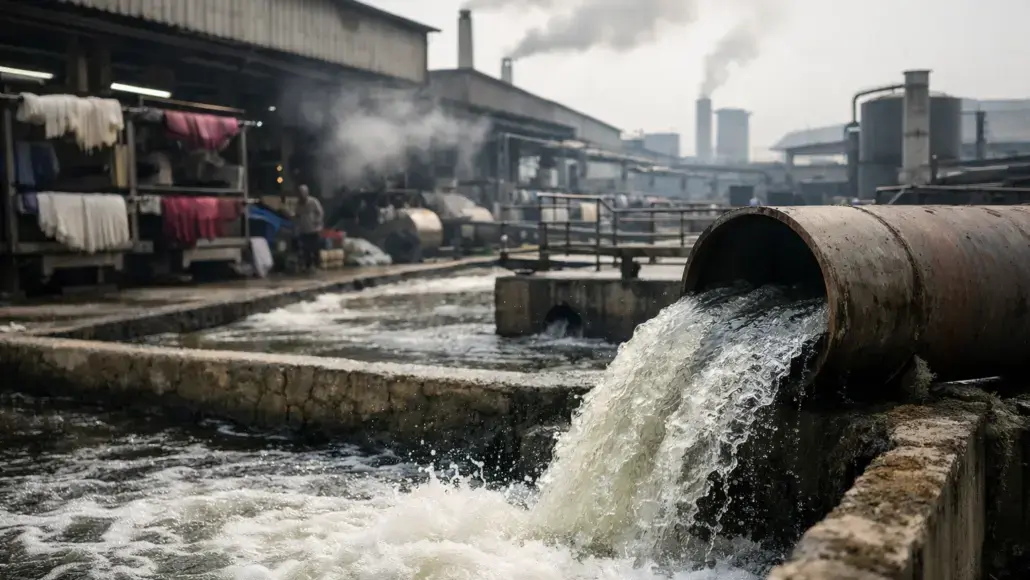
China has introduced a tougher national standard for textile wastewater discharge, raising the bar for mills, dye houses, and finishing operations across the country. The updated regulation replaces an older framework and introduces significantly more stringent limits on pollutant concentrations permitted in effluent released from textile manufacturing facilities.
The new standard, which falls under the country’s broader push to tighten environmental controls on industrial operations, directly impacts the wet-processing segment of the textile supply chain — an area long identified as one of the most water-intensive and chemically demanding parts of the industry.
What the New Standard Covers
The updated regulation introduces tighter controls on a range of parameters, including chemical oxygen demand (COD), ammonia nitrogen, total phosphorus, pH levels, and suspended solids, among other pollutants commonly associated with textile effluent. Discharge limits under the new rules are considerably lower than those permitted under the previous standard, meaning that facilities will need to invest in more advanced treatment technologies or improve their existing systems to remain compliant.
The standard applies to direct dischargers — those releasing wastewater into natural water bodies — as well as indirect dischargers, which channel effluent into municipal sewage systems. Both categories face stricter requirements under the new framework, though the limits differ based on the type of discharge route.
Scope of Application
The regulation covers a wide range of textile operations, including cotton, wool, silk, linen, and synthetic fibre processing, as well as dyeing and finishing processes. Facilities engaged in printing and finishing operations are also within the scope of the new standard. This broad application means that a significant portion of China’s textile manufacturing base will need to assess its current treatment capabilities against the revised requirements.
Implementation Timeline and Transition Period
Newly constructed or significantly upgraded facilities are expected to meet the new discharge limits from the point of adoption, while existing operations have been granted a transition period to align their processes and infrastructure with the updated requirements. The standard sets a clear deadline by which all covered facilities must comply, giving the industry a defined window to upgrade treatment systems, retrain operational staff, and conduct internal audits.
Industry Response and Compliance Pressure
The introduction of stricter textile wastewater rules comes as China continues to enforce and expand its environmental regulatory framework. Textile manufacturers — particularly those in regions with high concentrations of dyeing and finishing capacity — are expected to face meaningful capital expenditure requirements as they work toward compliance. Facilities that fail to meet the new discharge standards risk penalties, operational suspensions, or forced closures under China’s environmental enforcement regime.
For suppliers operating within international brand and retailer supply chains, compliance with the new China water standard is also likely to carry commercial implications, as environmental performance increasingly forms part of sourcing and audit criteria applied by global buyers.
Significance for the Textile Supply Chain
China remains the world’s largest textile producer and exporter, and its domestic regulatory decisions carry weight across global supply chains. The tightening of textile effluent discharge rules reinforces a direction of travel that has been underway for several years, with Chinese authorities progressively narrowing the gap between permitted industrial discharge levels and broader environmental protection goals.
Textile wastewater has historically been one of the more challenging areas of industrial effluent management due to the diversity and complexity of chemicals used in dyeing and finishing processes. The new standard reflects an acknowledgment by regulators that previous limits were insufficient to adequately protect receiving water bodies and downstream water quality.
Brands and retailers sourcing from Chinese mills will need to monitor how their supplier base responds to the updated China environmental compliance requirements, particularly those facilities engaged in dyeing, printing, and finishing — processes that generate the highest volumes of chemically loaded effluent.
Treatment Technology Implications
To meet the tighter limits on COD, nitrogen, phosphorus, and other regulated parameters, many facilities are expected to require upgrades to their textile wastewater treatment infrastructure. This may include the adoption of advanced oxidation processes, membrane bioreactor systems, or enhanced coagulation and flocculation technologies, depending on the specific nature of the effluent generated and the current state of on-site treatment capacity.
The new standard effectively signals that basic biological treatment systems, which were adequate under the previous framework, may no longer be sufficient for direct discharge facilities or for those feeding into municipal networks with limited headroom for incoming industrial loads.
Monitoring and Verification
The revised regulation also places greater emphasis on monitoring and verification mechanisms, requiring facilities to demonstrate ongoing compliance rather than relying solely on periodic inspections. This points toward a greater role for real-time or continuous effluent monitoring technology within compliant textile manufacturing operations.
Broader Context: China’s Environmental Regulation of Textiles
The new textile wastewater standard is part of a wider pattern of regulatory tightening across China’s manufacturing sector. Over recent years, Chinese authorities have progressively strengthened rules governing air emissions, solid waste disposal, chemical management, and water discharge from industrial facilities. The textile and apparel sector, given its scale and environmental footprint, has been a consistent focus within this regulatory evolution.
For the global textile industry, the direction being set by China’s updated discharge rules on textile effluent discharge aligns with similar movements in other major manufacturing and consuming markets, where pressure on mills to demonstrate measurable environmental performance is intensifying. The adoption of a stricter domestic standard by the world’s largest textile-producing nation is a development that will be closely watched by brands, certification bodies, NGOs, and regulators in other jurisdictions.