





















Vietnam and the United Kingdom (UK) are looking to deepen financial cooperation by developing commodity derivatives and other risk-management tools that could help exporters navigate volatile raw-material prices, logistics expenses and international market conditions.
The discussions took place at the Vietnam-UK High-Level Conference 2026 in Hanoi, where the two countries examined opportunities across financial services, fintech, artificial intelligence, logistics, crypto assets and commodity markets.
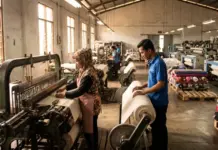
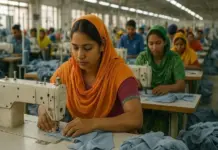
For Vietnam’s textile and apparel sector, the proposed development could be particularly relevant. Manufacturers and exporters often face fluctuations in cotton, synthetic fibres, energy, freight and other production costs. Greater access to financial hedging instruments could provide businesses with improved cost visibility and greater protection against sudden market movements.
Commodity derivatives seen as risk-management tool
Vietnam’s Deputy Minister of Industry and Trade Phan Thị Thắng said the country wants to establish a commodity trading and derivatives market that is transparent, secure and professionally managed.
The objective is to connect financial products more closely with the requirements of producers, traders and import-export businesses rather than developing a market disconnected from the real economy.
A functioning commodity derivatives market in Vietnam could eventually cover a broad range of industries, including textiles, metals, energy, coffee, rubber, animal feed and transportation.
For textile exporters, the ability to manage commodity price exposure could become increasingly valuable as international sourcing costs remain vulnerable to geopolitical developments, currency movements, energy prices and changing demand.
UK expertise to support financial-market development
Vietnam is also looking to draw on British experience in areas such as financial regulation, governance, risk-based supervision, regulatory sandboxes and investor protection.
The UK has previously shared expertise on commodity derivatives, including during the International Financial Centre Conference held in Hanoi in March. This earlier engagement could provide a foundation for further cooperation on market infrastructure, financial products and regulatory frameworks.
Vietnam’s plans for international financial centres in Ho Chi Minh City and Da Nang form another important part of the country’s strategy to create a more integrated and internationally competitive financial ecosystem.
According to Thắng, Vietnam’s future growth will require stronger productivity and more efficient mobilisation of both domestic and international capital. Building modern financial markets is expected to play a role in that transition.
Potential benefits for textile supply chains
The development of commodity derivatives in Vietnam could complement existing risk-management measures used by textile and apparel companies.
Exporters could potentially use appropriate financial instruments to manage exposure to raw-material prices and other commodity-related costs. This could make budgeting and production planning more predictable, particularly for businesses operating on tight margins.
The benefits could extend beyond manufacturing. Vietnam and the UK are also exploring cooperation in trade finance, logistics finance, insurance and supply-chain risk management.
Vietnam is seeking to build a logistics system that is more integrated, digital and environmentally sustainable, while the UK can contribute experience in areas including marine insurance, port technology, trade finance and supply-chain management.
Wider financial cooperation
The two countries also discussed closer regulatory engagement in fintech, artificial intelligence, data management and cybersecurity.
Green finance, insurance and supply-chain finance were identified as additional areas where stronger bilateral cooperation could support businesses and investment.
For textile companies, these developments could eventually create a broader financial ecosystem capable of supporting not only commodity-risk management but also working capital, trade transactions, insurance and international logistics.
Bilateral trade continues to expand
The financial cooperation agenda comes against a backdrop of growing Vietnam-UK commercial ties.
Two-way trade was reported at almost $9.4 billion in 2025, while bilateral trade during the first seven months of 2026 approached $6 billion, representing year-on-year growth of 14.5%.
The UK-Vietnam Free Trade Agreement (UKVFTA) continues to provide the framework for bilateral trade, while the UK’s participation in the Comprehensive and Progressive Agreement for Trans-Pacific Partnership (CPTPP) has further strengthened opportunities for trade and investment.
For Vietnam’s textile and apparel exporters, deeper financial cooperation with the UK could therefore complement these trade agreements by providing additional tools to manage the commercial risks associated with increasingly complex global supply chains.