































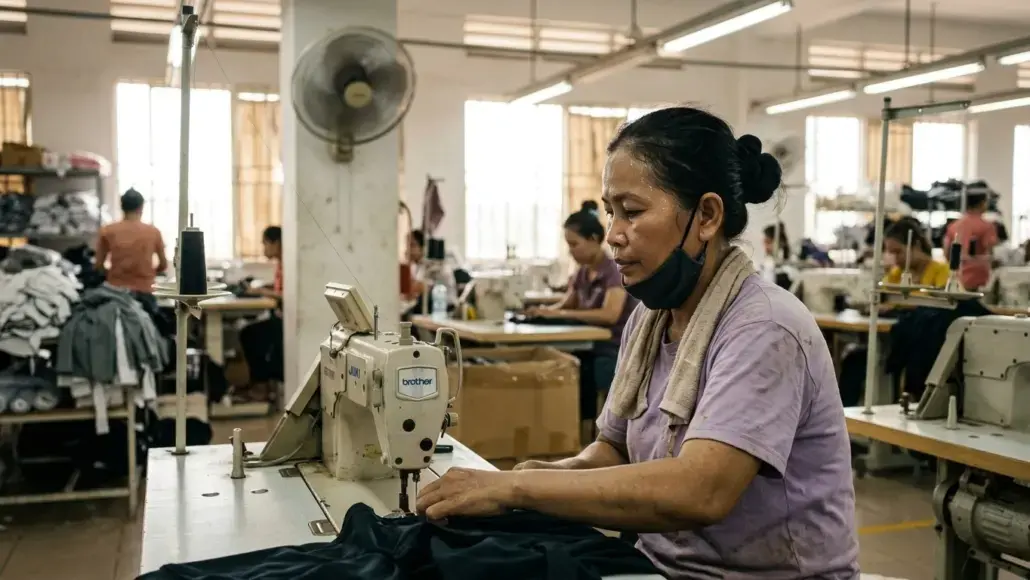
A new report has warned that rising workplace temperatures could significantly affect Cambodia’s garment, footwear, and travel goods (GFT) industry, with productivity and export earnings projected to decline unless comprehensive measures are introduced to protect workers from heat-related risks.
The study, “Mitigating Heat Stress in the Garment, Footwear and Travel Goods Sector,” was prepared by GIZ in collaboration with experts from Cornell University’s Global Labor Institute (GLI), the International Labour Organization (ILO), the International Finance Corporation’s (IFC) Better Work programme, and other technical specialists. Drawing on consultations held in Phnom Penh in January 2026, the report outlines practical recommendations for improving occupational heat management across the country’s apparel manufacturing sector.
The Cambodia garment heat stress challenge has become increasingly severe as extreme temperatures continue to rise. According to the report, Phnom Penh has experienced one of the sharpest increases in extreme heat days among major global apparel manufacturing hubs. Annual days with temperatures above 35°C climbed from an average of 35 days between 2005 and 2009 to 112 days during 2020–2024.
Factory conditions reflect this trend. The report found that 82% of manufacturing facilities recorded indoor temperatures exceeding 32°C in their hottest production areas.
It states: “One in three factories experienced days when indoor temperatures exceeded 35°C. Almost 53% of factories recorded indoor temperatures above 32°C while also being hotter than concurrent outdoor temperatures.”
Worker Health Under Pressure
The report highlights that excessive heat poses serious occupational health and safety concerns for Cambodia’s GFT industry, which employs approximately 1.2 million workers.
Production facilities often combine heat-generating machinery, inadequate ventilation, crowded workspaces, physically demanding tasks, and protective clothing that traps body heat. These conditions increase the likelihood of dehydration, fatigue, heat exhaustion, heat stroke, reduced concentration, discomfort, and workplace accidents while also raising the risk of long-term health complications.
Women, who account for around 78% of the industry’s workforce, face particular challenges. The report notes that pregnant employees and those engaged in physically intensive work are especially vulnerable to prolonged heat exposure, reinforcing the need for targeted workplace protection measures.
Economic Consequences
Beyond worker wellbeing, the report warns that Cambodia garment heat stress could weaken the country’s export competitiveness. The GFT industry generated US$15.7 billion in export earnings during 2025, making it one of Cambodia’s most important economic sectors.
However, prolonged exposure to high temperatures reduces worker efficiency through “presenteeism,” where employees remain at work but are unable to maintain normal productivity. Heat-related illnesses also contribute to absenteeism and increase the likelihood of workplace errors and accidents.
The report states: “Together, these effects translate into reduced productivity, lower wages for piece-rate workers, and broader losses for businesses and national economies in garment-producing regions.”
Without effective adaptation measures, Cambodia’s apparel sector could lose 18% of its potential export earnings by 2030, while creating approximately 50,000 fewer new jobs than expected.
Recommended Actions
The report calls for coordinated action involving government agencies, manufacturers, global brands, and worker representatives to improve heat resilience across the sector.
Among its recommendations are stronger occupational safety regulations, wider adoption of heat monitoring systems, and revisions to Cambodia’s 2002 Ministerial Regulation on Workplace Thermal Environments (Prakas 147) to introduce heat-specific occupational safety standards.
Manufacturers are encouraged to conduct formal heat-risk assessments and establish written heat management plans that include improved ventilation, reliable access to drinking water, scheduled rest breaks, and other workplace cooling measures.
The report also encourages international buyers sourcing from Cambodia to publicly support heat-safe manufacturing by aligning purchasing practices with responsible workplace standards.
Concluding its findings, the report states: “Heat stress is a shared risk and a shared responsibility. Regulation alone will not solve it. Nor will isolated factory pilots or individual brand initiatives. Cambodia needs a coordinated sector response built around measurement, prevention, worker participation, buyer alignment, and practical factory support.
“The opportunity is clear. By acting early, Cambodia can protect workers, reduce productivity losses, strengthen compliance, and show global buyers that its GFT sector is preparing seriously for a hotter climate. Heat-safe production should become part of Cambodia’s responsible sourcing proposition. In a warming world, it is not only about good worker protection. It is a sound industrial strategy.”

