

























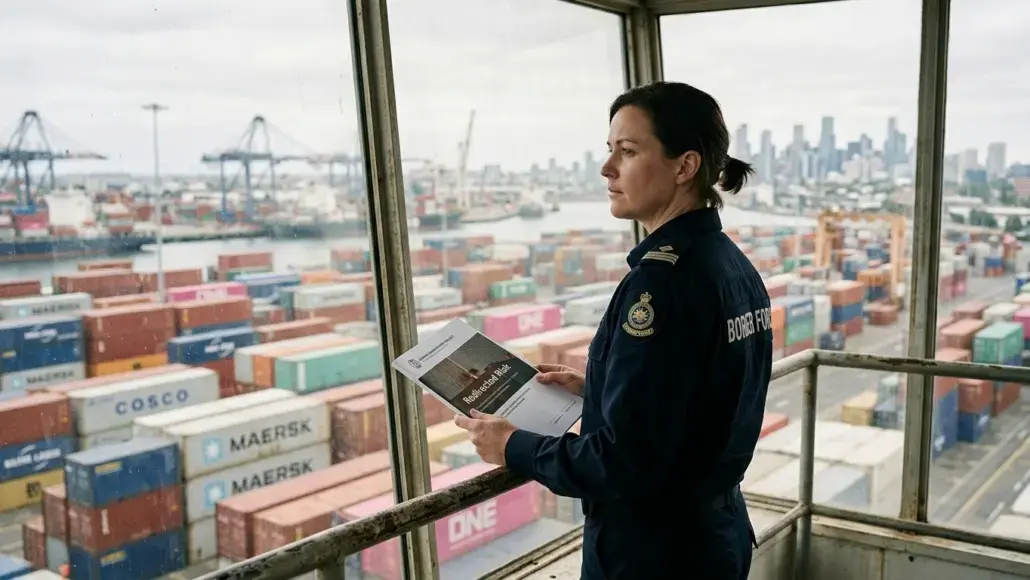
Australia and Japan could become fallback destinations for goods linked to Uyghur forced labour, according to a new report from the Uyghur Human Rights Project (UHRP), which argues that both countries have meaningful policy commitments but limited enforcement tools at the border.
The study, Redirected Risk: Uyghur Forced Labor and the Enforcement Gap in Australia and Japan, was written by UHRP research associate Elijah Pockell-Wilson. It compares the two markets with tougher approaches in the United States and the European Union, warning that stricter regimes elsewhere can unintentionally push suspect supply chains toward jurisdictions with fewer import controls.
Using 2024 trade data alongside a review of existing supply-chain policies, the report estimates Australia imported about $4.82 billion worth of goods from sectors considered highly exposed to Uyghur forced labour risk. For Japan, the equivalent figure was roughly $6.71 billion. The report identifies several categories with elevated exposure, including cotton textiles and apparel, solar supply-chain inputs, aluminium and chemicals.
UHRP argues the policy direction in the US particularly under the Uyghur Forced Labor Prevention Act (UFLPA) and the EU’s developing measures are narrowing entry points for goods produced with forced labour indicators. In contrast, markets without comparable border restrictions may face a “rerouting” effect.
Pockell-Wilson said: “Forced labour does not disappear when one market tries to close its doors. Without stronger import controls, Australia and Japan risk becoming destination markets for goods made with Uyghur forced labour that other countries are working to block.”
The report notes that Australia’s current framework leans heavily on the Modern Slavery Act, while Japan’s approach relies on human rights supply-chain guidelines. In UHRP’s assessment, neither framework compels companies to present proof at import that products are free from forced labour, leaving enforcement capacity limited even as international concern intensifies over state-imposed labour practices in East Turkistan.
UHRP executive director Omer Kanat said voluntary measures are not sufficient to address a state-driven system. “Governments cannot rely on voluntary corporate compliance to address a system of state-imposed forced labour. Australia and Japan have committed themselves to international human rights standards, but those commitments must be backed by enforceable laws. Without stronger action, goods linked to the repression of Uyghurs can continue to reach consumers through markets that lack meaningful safeguards.”
Among its recommendations, UHRP calls for Australia and Japan to adopt forced-labour import bans modelled on the UFLPA and to introduce mandatory, evidence-based human rights due diligence requirements. The report also urges stronger customs powers, better traceability across supply chains, and closer coordination with US and EU enforcement efforts. It further recommends that policymakers include civil society groups and affected communities in enforcement processes to strengthen legitimacy and oversight.